
The statement came in the backdrop of rumours doing the rounds that China occupied 20 kms of Indian territory at Tawang sector and 8 kms at Taksing in Upper Subansiri district.

Wing Commander Pratap Marathe's story is one of dedication, bravery, and humour, a shining example of the spirit of the Indian Air Force. Air Commodore Nitin Sathe (retd) salutes Wing Commander Marathe who passed into the ages last week.
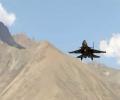
The Indian Air Force will carry out a mega exercise covering the Northeastern region early next month to check its combat readiness, amid a fresh spike in tension with China along the Line of Actual Control in Arunachal Pradesh.

This move is seen as part of efforts to strengthen China's ties with Pakistan and safeguard Chinese investments in Pakistan-occupied Kashmir, particularly related to the China-Pakistan Economic Corridor.

'Pakistan is a nuclear country.' 'With the kind of situation that is there in Pakistan today, America will help Pakistan stay afloat.'

'China's action towards India really gives you a good insight into how the Communist Party of China is thinking these days'
Senior officers recounted extreme Chinese brutality to the Indian prisoners, with some of them being pushed over cliffs and soldiers' bodies being recovered from the Galwan River.

China has increased its antics in Taiwan Strait post the visit of US House Speaker Nancy Pelosi to the self-governed island.

'Given China's past behaviour and their territorial claims, should we be sceptical regarding China's willingness to adhere to these agreements fully? The answer is yes.' 'As Ronald Reagan famously said in the context of the SALT talks, 'Trust, but verify!' India should also do the same.' 'This has already begun with foot patrolling, drones, satellite imagery and so on. India's military deployment did mirror China's and will continue to do so in the future.'

The Indian and Chinese armies have been locked in a bitter standoff at multiple locations in eastern Ladakh for over eight weeks since May 5.
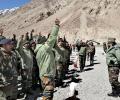
On development of infrastructure by China in border areas, the Army chief said it is going on unabated.

'We are facing the most critical military situation with China in the last 50 years.'

Topics like 'Boycott China', 'Go China' and 'Go Chinese Go' have been trending on Twitter.

The sources said the situation in eastern Ladakh remained 'tense' and that around 30-40 soldiers of China's People's Liberation Army (PLA) are holding up at a position close to an Indian post in the Rezang-La ridgeline in eastern Ladakh.

'Disengagement is merely the first step in a lengthy process of arriving at a new normal along the LAC in Eastern Ladakh and the entire land boundary.' 'The Indian government should insist on the restoration of the status quo ante in Eastern Ladakh.'
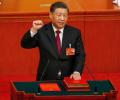
Xi is widely expected to continue in power for life.
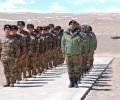
Chinese foreign ministry spokesperson Mao Ning told the media in Beijing on Monday that the two sides held an in-depth exchange of views on expediting the resolution of relevant issues.

The India Army troops rose to the occasion to the challenges along the northern border as likely contingencies and possible options were war-gamed beforehand, Army Chief Gen M M Naravane said on Wednesday, referring to the eastern Ladakh standoff with China.
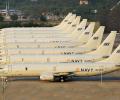
Troops of India and China were locked in a standoff in Doklam from June 16, 2017 after the Indian side stopped the building of a road in the disputed area by the Chinese Army.

The incident had taken place at a time when the Indian Foreign Minister, S Jaishankar, was in Moscow for the Shanghai Cooperation Organisation meeting, where he met his Chinese counterpart to address the border issues.
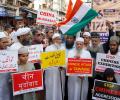
Protests in Mumbai and Jammu denounce the Chinese government after Chinese soldiers clashed with Indian troops in Arunachal Pradesh.

Sources said the Indian delegation was warmly greeted by senior officials of the Chinese Army before the talks began.

Almost five years later, the three services have still not fully understood that joint/theatre commands are not a discussion point; they are the prime minister's diktat on a military reform measure that is in line with what armed forces around the world have implemented, points out Ajai Shukla.

'We have to be prepared on the borders to withstand Chinese expansionist designs.'
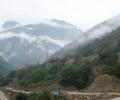
"A strict vigil is being maintained in almost all the sectors with China from Ladakh to Arunachal Pradesh as the Chinese suffered a setback in the southern Pangong Tso area and may try to make fresh attempts to ingress into newer dormant areas," government sources told ANI.

According to the Ministry of National Defence, the planes included six J-11 fighter jets, six J-16 fighter jets, two Xi'an H-6 bombers, two KJ-500 airborne early warning and control aircraft, one Shaanxi Y-8 anti-submarine warfare plane, and one Shaanxi Y-8 electronic warfare aircraft, reported Taiwan News.
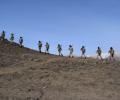
The enhancement of combat capability by the two armies in the region came even as both the countries continued their efforts to resolve the dispute through talks at military and diplomatic levels.
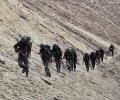
The Army on Tuesday said it was prepared to give an appropriate response to any adverse aggressive designs of China in the Ladakh sector, maintaining that the integrity of the country was being ensured through physical patrolling and technical means.

While Indian Army soldiers are engaged in a standoff with the Chinese People's Liberation Army in Ladakh, the army's Eastern Army commanders are taking no chances in Arunachal Pradesh.
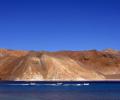
"As regards reports about a bridge being made by the Chinese side on Pangong Lake, the government has been monitoring this activity closely," External Affairs Ministry Spokesperson Arindam Bagchi said.
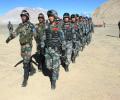
"We hope the Indian side will move towards China and through concrete actions implement the consensus and continue the close communication through military and diplomatic channels to jointly push for the de-escalation on the border region," Zhao said.
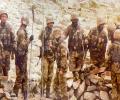
As tension escalated at the Line of Actual Control (LAC), the sources said around 50-60 soldiers of Chinese People's Liberation Army (PLA) approached the Indian post in the southern bank of Pangon lake area at around 6 pm but the Indian Army personnel posted there strongly confronted them, forcing their retreat.

China on Thursday said the meeting between Prime Minister Narendra Modi and Chinese President Xi Jinping in Russia's Kazan on Wednesday carries a "great significance" as they reached an "important common understandings" to improve the bilateral ties.
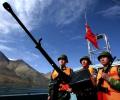
After making incursion bids in Ladakh through land route, Chinese troops have made several attempts to enter Indian waters at Pangong lake nestled in the higher reaches of Ladakh with the latest incident reported on Friday.
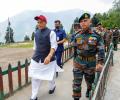
There seems to be a desire for opacity when it comes to confronting China, points out Aakar Patel.

'I was exhausted, hungry, unshaven and despondent.' 'My mouth was full of sores due to dehydration.' 'My clothes were in tatters due to walking through bushes and sliding down thorny slopes,' Brigadier John Parshuram Dalvi wrote of his capture during the 1962 War.

'With continued focus on votes, upcoming by-polls and purchasing politicians, the political hierarchy has little time for national defence.' 'They would do well to heed a veteran scholar, who says, "There will be war with China in the next few years. The next full scale war will have the involvement of Pakistan and terror elements, insurgents and intelligence assets operating inside India",' warns Lieutenant General Prakash Katoch (retd).

General Zhao Zongqi is well known in India for having commanded the Chinese troops during the Dokalam episode. Zhao knows every inch and corner of the Indian border, at least the Eastern and Central sectors, including the Naku La area which witnessed fist-fights between Indian and Chinese troops in April/May. Claude Arpi introduces us to the PLA generals masterminding the Chinese aggression in Ladakh.

India recently outflanked China by taking control of strategic height near Pangong lake's southern bank.
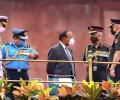
Defence Minister Rajnath Singh is likely to call another high-level meeting later today, they added.
